The average adult makes 33,000 to 35,000 decisions each day. With so many decisions to navigate, most people prefer having fewer options rather than being overwhelmed by too many choices. In many cases, less truly is more—especially regarding records retention schedules.
Creating and managing retention schedules can be daunting with complex and ever-evolving privacy laws and industry, state, and federal regulation requirements. This is where the Big Bucket approach comes into play. The Big Bucket approach simplifies compliance by grouping records into broad categories with fewer retention rules compared to traditional, granular schedules with specific categories and numerous retention guidelines. This functional method makes retention scheduling much simpler and more efficient.
Continue reading to discover why today’s organizations are adopting the Big Bucket approach and whether it’s the right structure based on your organization’s needs.
What is the Big Bucket Approach?
Retention schedules should be based on groups of related records rather than individual records—this is the foundation of the Big Bucket approach. The overall goal of this approach is to create as few record categories—or “buckets”—as necessary to meet an organization’s needs. This allows businesses to organize records with similar retention needs into broader categories, making filing, managing, and evaluating them easier.
Before this approach became popular, businesses typically relied on separate departmental retention schedules, which were granular and confusing and caused records to be duplicated across different departments. By shifting to a functional Big Bucket approach, organizations can consolidate records into broader categories based on activities, business processes, and functions. For example, instead of maintaining separate retention schedules for each department or business unit’s policies and procedures, there is one single record series under a specific business function for company-wide policies and procedures. This approach reduces record duplication and makes compliance more straightforward.
Why Do Organizations Use the Big Bucket Approach?
There are numerous benefits to utilizing the Big Bucket approach; the key reason is simplicity. Long, detailed retention schedules are overwhelming, especially when employees are unsure which record series to choose. It also takes significant time and effort to determine where a record belongs, which department should own it, and how to access the right series. By consolidating records into broader, functional categories, the Big Bucket approach minimizes confusion, increases efficiency, and reduces the time spent searching for the right documents. Other advantages that the Big Bucket approach offers include:
- Easier Retention Assignment: Auto-classification tools and employees can assign the correct retention to records easily.
- Consistent Retention and Disposal: The approach improves the ability to retain and dispose of records in compliance with retention policies.
- Less Redundancy: The volume of repeated legal citations and citation mapping updates is significantly reduced with this approach.
- Simplified Compliance: By organizing records in broader, functional buckets, compliance is streamlined.
- Flexible and Adaptable: The approach allows easy modifications as business processes evolve.
Illuminating the Path to Information Clarity: Reflections from 2025
In Illuminating the Path to Information Clarity: Reflections from 2025, we’ll revisit the pivotal moments, insights, and innovations that shaped the year and explore what’s on the horizon for records and information management professionals in 2026.
Structure of a Big Bucket Retention Schedule
The Big Bucket approach follows a hierarchical structure with business function at the highest level, followed by record series/buckets and, finally, content types. The business function represents the organization’s functions and processes, not a specific business unit or department (although they sometimes have the same name). Within each business function, multiple record series/buckets are applied, and various content types are categorized within each of these buckets. The content types inherit their retention period from the record series they are bucketed into or mapped. Visually, here’s an example of this structure:
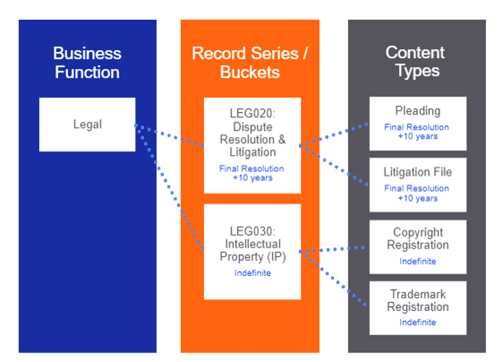
To maximize the benefits of the Big Bucket approach, mid-sized and large companies should aim to have roughly 100-120 record series/buckets. The goal is to avoid having buckets too broad; otherwise, managing records that are grouped too generically becomes confusing and challenging.
Big Bucket Approach Challenges
While the Big Bucket approach streamlines the retention schedule process, the following are a few challenges to keep in mind:
- Developing and implementing a Big Bucket retention schedule is a complex and time-consuming process that requires strong management support, stakeholder buy-in, and user training. Additionally, transitioning to the Big Bucket approach requires applying new retention rules to older records in offsite storage, some of which may not have been appropriately categorized initially.
- Event-based retention can be challenging to implement effectively. In many cases, eliminating event-based retention triggers may not be feasible for specific record series—such as project records, personnel files, case records, and client records—that must be retained for some time after the event or matter has concluded.
- Depending on the business’s needs, there may be a need for more granular or detailed retention schedules to comply with specific regulations or to manage records with strict retention periods.
Is the Big Bucket Approach Right for Your Organization? According to an ARMA International study, most organizations find the Big Bucket approach user-friendly and effective in meeting legal and operational requirements. While there are many benefits to implementing this approach, it’s essential to do thorough research before making the switch. When determining if the Big Bucket approach is right for your organization, consider company size, business needs, the complexity of records managed, and privacy and regulatory requirements. By evaluating these factors, you can determine whether the Big Bucket approach will enhance your records management processes and improve organizational efficiencies.
Additionally, consulting with an expert or vendor may help determine if your organization would benefit from the Big Bucket approach. Schedule a free 30-minute consultation with our information governance and retention schedule experts to learn how your organization can reduce retention schedule management costs and improve the efficiency of your teams.
Schedule a Retention Consultation Now








Share